Program Update 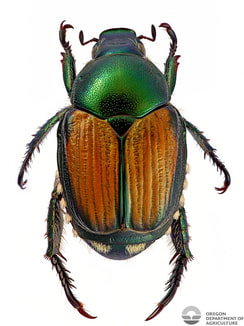
The Oregon Department of Agriculture (ODA) will continue Japanese beetle eradication and monitoring efforts in 2026. Oregon House Bill 5204 allocated $1.8M to continue the Japanese beetle (JB) Program over the 2026 and 2027 crop years. During the previous legislative session funding was not allocated for the JB program, and the agency has spent the past several months working with partner states in the west to facilitate the movement of Oregon plant products, such as nursery stock – the states’ largest agricultural sector. This renewed investment reflects a strong commitment to the agency’s mission to protect Oregon and promote key agricultural sectors.
Next Steps
Beginning in March, Online consent forms and notifications will begin being sent to properties in affected areas to request consent for treatment of JB. We strongly encourage that residents fill out the consent form as soon as notifications are sent and received. Treatment applications are time sensitive as they must be applied at the right time to be effective. Consents are necessary for the Department to begin treating. Treatment consent will primarily be done online this year, using the link and PIN provided in the pending notifications. The program anticipates beginning treatments as early as mid-April and trap placement to begin in late-April to early May in those areas where beetles are known to exist. A map of 2025 catch sites and the planned treatment area for 2026 can be found
here. Traps will also be placed in other parts of Oregon to look for new beetle introductions. These activities run from early spring through end of September.
ODA would like to extend gratitude to the residents and communities for their continued support and cooperation in helping protect Oregon’s agriculture, nurseries and natural areas from Japanese beetle.
Status of Japanese beetle in Oregon
Oregon maintained full program activity throughout 2025. This work reduced beetle numbers by 65% from the previous year and by 92% since 2016. Recent survey data for 2025 showed that 1,918 beetles were trapped across Oregon, with most captured at a single property in Washington County.
The Japanese beetle (Popillia japonica) continues to pressure Oregon and other western states. Although introduced to Oregon multiple times since the 1980’s, the largest infestation was found in 2016 in the Cedar Mill, Bonny Slope, Oak Hills, and Bethany areas of Washington County. Smaller populations were later found in Clackamas and Multnomah Counties. In 2025, one beetle was found in each of Marion and Union Counties. The Department will address all new detections in its 2026 work.
The Japanese beetle (Popillia japonica) continues to pose a significant pressure on Oregon and other western states. The largest infestation in Oregon was found in 2016 in the Cedar Mill, Bonny Slope, Oak Hills, and Bethany areas of Washington County. This invasive insect pest can be destructive in multiple life stages, causing damage to over 300 types of plants including roses, hops, grapes and a myriad of ornamental plants. If left unmanaged, the current population will continue to grow and spread to new areas within Oregon. Increased beetle populations lead to more pesticide use to protect crops and gardens.
How can I prevent the spread of Japanese beetle?
If you live in or near the
infested area there are a couple of ways you can help limit the spread of Japanese beetle. The best way to help limit the spread of Japanese beetle currently is to ensure you are not moving any plant material, including outdoor potted plants, to new locations outside of Washington County. Also, please refrain from participating in any plant swaps if you are within the infested area. Japanese beetle can be moved in a variety of ways, including in potted plants. It is likely that the current population was introduced from a potted plant that was moved into the neighborhood from a Japanese beetle infested area outside of the state.
To help ODA reduce the current population of JB, be on the lookout for treatment notifications and submit your consent form online at your earliest convenience. Hosting a trap in your yard and keeping an eye on traps placed in your neighborhood also helps to support the ODA's efforts. State employees may ask for access to your property to place and check insect-monitoring traps.